habitat.

CSRD does not stop
at the EU border.

Your company may never publish a CSRD report. Your customer might.

CSRD in Kosovo is felt through customers, not regulators. European companies reporting under the Corporate Sustainability Reporting Directive depend on data from suppliers throughout their value chains — and that can include businesses in Kosovo, without any local regulation being required.

How it reaches you

The sustainability data supply chain.

Even where a company is not directly subject to CSRD, its customer may be. And your data becomes part of their data.

EU reporting requirement
European company
Procurement department
Supplier questionnaire
Your company in Kosovo

No Kosovo regulation was required for the request to arrive. The market transmitted it.

"Approximately sustainable" is not a dataset — the quality of the response matters.

What gets requested

A Kosovo supplier may
receive requests covering:

Requests vary between customers, but they tend to draw on the same underlying set of environmental, social and governance information.

  • Energy consumption
  • Scope 1 emissions
  • Scope 2 emissions
  • Scope 3 information
  • Renewable energy
  • Environmental practices
  • Environmental policies
  • Waste
  • Water
  • Workforce information
  • Sustainability policies
  • Governance
  • Climate targets
How Habitat helps

Build the infrastructure once.

01 / Readiness

Readiness assessment

We identify what sustainability information your organisation already has and what is missing.

02 / Structure

ESG data structure

We establish responsibilities, datasets and documentation — so the same underlying data can support multiple requests.

  • Data owners
  • Reporting periods
  • Source documents
  • Calculation methodologies
  • Emission factors
  • Version histories
  • Assumptions
03 / Metrics

Environmental metrics

We support the development of measurable environmental information.

04 / Inventories

GHG inventories

Karbon360° enables companies to structure greenhouse-gas information across Scope 1, Scope 2 and relevant Scope 3 categories.

  • Scope 1
  • Scope 2
  • Relevant Scope 3
  • Audit trails
05 / Reporting

Reporting preparation

We organise information so it can be used in sustainability questionnaires, customer requests and reporting processes — rather than rebuilt from scratch every time a questionnaire arrives.

Why it matters

Your sustainability data is becoming part of your product.

For suppliers competing internationally, the value proposition increasingly includes more than the physical product. Buyers want information about how that product was produced — quality data, traceability, environmental data, carbon data, labour information, compliance information.

Companies able to provide these quickly reduce friction for their customers. And reducing friction is a competitive advantage.

Climate technology built in Kosovo

Karbon360°

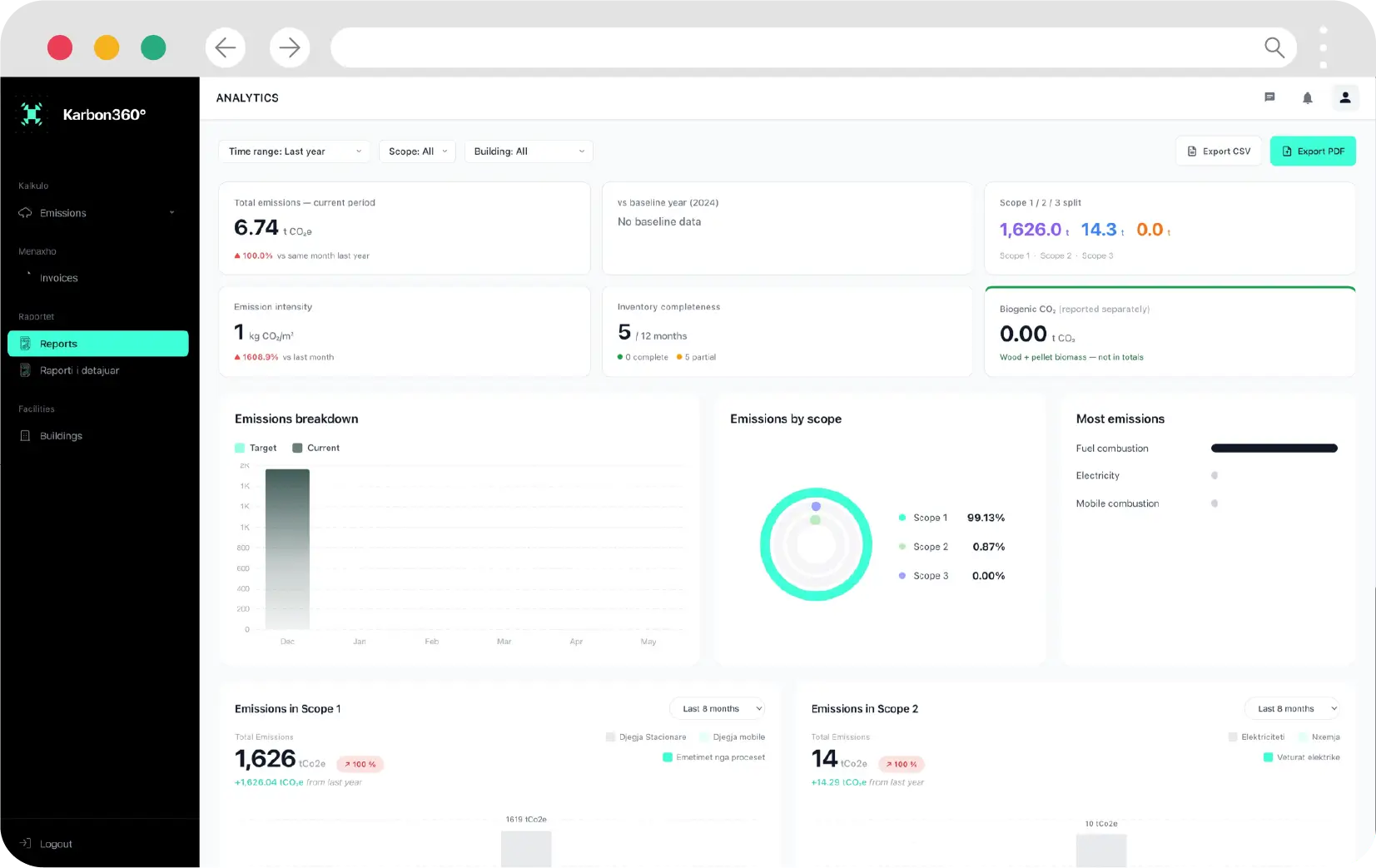
Karbon360° transforms energy and business activity data into structured greenhouse-gas inventories built on the GHG Protocol — the dataset behind every supplier questionnaire you answer.
  • Scope 1, 2 & 3
  • GHG Protocol inventories
  • CSRD & ESRS-related data
  • EU Taxonomy alignment
  • Emission-factor traceability
  • Audit trails
Karbon360 platform showing structured greenhouse gas data for CSRD and ESRS reporting
Related

Explore further.

FAQ

Frequently asked.

Some Kosovo businesses can be indirectly affected because European companies subject to sustainability reporting may request ESG and emissions information from suppliers outside the EU.

Requests vary, but can include energy consumption, fuel consumption, Scope 1 emissions, Scope 2 emissions, Scope 3 information, renewable energy, environmental policies, waste, water, workforce metrics and climate targets.

ESRS are the European Sustainability Reporting Standards — the standards used by companies reporting under CSRD. They shape the structure and content of the sustainability information those companies collect, including the information they request from suppliers.

Create a central ESG data structure. Define data owners, reporting periods, source documents, calculation methodologies, emission factors, version histories and assumptions. The same underlying data can then support multiple requests.
Talk to habitat

Build it once.
Answer it every time.

Talk to Habitat about CSRD and ESRS readiness, ESG data structure and the information your EU customers will ask for.

www.worldofhabitat.com