01 / Exposure
CBAM exposure assessment
Understand whether products and exports may fall within CBAM-related requirements.
- Product classification
- Export markets
- Sector screening

Carbon now has a place in the cost of accessing the European market.
CBAM reaches Kosovo through the European market rather than through local law. The European Union's Carbon Border Adjustment Mechanism changes how carbon-intensive products entering the EU are treated. For exporters in affected sectors, embedded emissions are becoming commercially relevant information.
CBAM does not simply ask how sustainable your company is. It requires product- and installation-related emissions information — and that changes the conversation.
CBAM initially focuses on carbon-intensive sectors including areas such as iron and steel, aluminium, cement, fertilisers, electricity and hydrogen. Product applicability depends on specific tariff classifications — so exporters should assess their actual products rather than assuming that their entire industry is either included or excluded.
Do not wait for the buyer to calculate your carbon exposure — a company that controls its environmental data is in a stronger position.
A company without a baseline may need to reconstruct months of information under deadline pressure. Our work can include:
Understand whether products and exports may fall within CBAM-related requirements.
Identify what operational, production and energy data is required.
Build traceable emissions information using recognised methodologies such as the GHG Protocol.
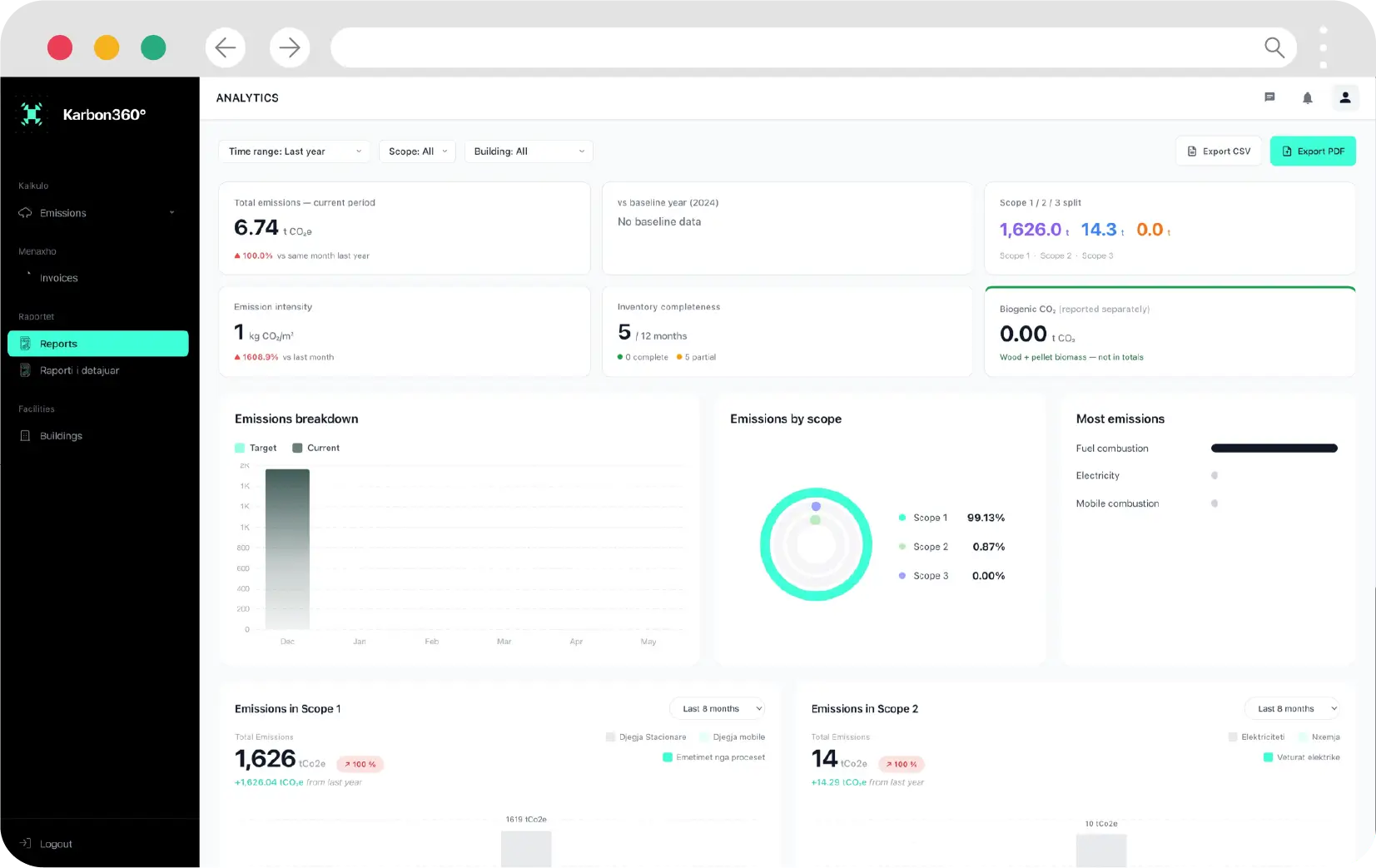
Use structured digital infrastructure to organise energy, activity and emissions data — with Karbon360°, our climate technology platform built in Kosovo.
Prepare emissions information when EU customers request it. In many cases a Kosovo exporter will experience CBAM through its EU importer — that importer needs information, and therefore the supplier needs information. A company that has already structured its operational and emissions data can respond faster and more credibly.
Companies should begin by identifying: which exported products may fall within CBAM; the facilities where those products are manufactured; the energy sources feeding production; whether energy and emissions information can be connected with production volumes; and whether every calculation can be supported by underlying documentation.
This is the fundamental change CBAM represents. For affected exporters, carbon information is no longer only sustainability information — it can affect market access, customer relationships, pricing and competitiveness.
Karbon360° transforms energy and business activity data into structured greenhouse-gas inventories and verifiable sustainability information — the underlying evidence CBAM-related requests depend on.
Talk to Habitat about CBAM readiness, emissions data and preparing for what your EU customers will ask for.
www.worldofhabitat.com