CBAM verification: the window is shorter than it looks.
The first CBAM declaration is due 30 September 2027, but the real deadline for producers comes earlier. Emissions for 2026 can only be verified from January 2027, the Commission expects importers to want verification reports by mid-August, every installation needs a physical site visit in its first verified year, and accreditation of CBAM verifiers only began in 2026. Producers who have not booked a verifier risk their customers declaring default values with a mark-up instead of their real numbers. Habitat prepares the data in Karbon360° so the verifier can check it, not rebuild it.
Three bottlenecks at once.
2026 is a calendar reporting period, so verification cannot finish before January 2027, and importers need the reports by mid-August to file by 30 September.
In the first year subject to verification, the verifier must visit each installation in person. Virtual visits only become possible after a physical one.
National bodies began accrediting CBAM verifiers in 2026. Luxembourg's competent authority expects the number of available verifiers to be limited at the beginning.
Verified or default: what changes.
| Verified actual emissions | No verified data in time | |
|---|---|---|
| What the importer declares | The producer's own installation-level emissions | Commission default values per good and country |
| Mark-up | None | 10% for 2026 imports, 20% for 2027, 30% from 2028 |
| Article 9 carbon price deduction | Based on the carbon price actually paid, with an operator's carbon price report | Only through Commission default carbon prices |
| Effect on the supplier | A documented, lower-risk supplier | A higher CBAM cost the buyer may pass back, or avoid by switching supplier |
Legal basis: Art. 7(2) and Art. 8 of Regulation (EU) 2023/956 as amended by Regulation (EU) 2025/2083; mark-ups under Implementing Regulation (EU) 2025/2621.
Accreditation, country by country.
CBAM verifiers are accredited by national accreditation bodies under Delegated Regulation (EU) 2025/2551, and the rules for verification are in Implementing Regulation (EU) 2025/2546. As of the Commission's 13 November 2026 overview, 24 national bodies had agreed to provide CBAM accreditation and 20 were ready to accept applications, but only seven accredit and accept applicants from outside the EU: France (COFRAC), Greece (ESYD), Italy (Accredia), the Netherlands (RvA), Poland (PCA), Slovakia (SNAS) and Sweden (Swedac).
Some have agreements that matter for exporters: RvA with Türkiye's TURKAK, and Swedac with Ukraine's NAAU, the UK's UKAS and India's NABCB. The Commission has said it will publish the list of accredited verifiers; as of 19 November 2026 it had not appeared. Accredited verifiers are also shown in the CBAM Registry.
Five steps to a verified 2026 report.
What makes verification fast.
- A monitoring plan: the methods, data sources and controls the verifier checks the report against, in the Commission's template.
- Clear boundaries: the installation, its production processes and the goods each one makes.
- Evidence for every input: invoices, meter readings and production records, linked to each figure.
- Named factors: every emission factor with its source and version.
- A calculation trace: each result traceable step by step to its inputs and the rule it applies.
- Precursor data: verified emissions for purchased precursors, or the default value used and why.
- One contact: someone who answers the verifier's questions the same day.
Built to get you verified.
A verifier's time goes into one question, asked hundreds of times: where does this number come from? Habitat answers it before the verifier asks. Every figure we prepare runs through Karbon360°, which keeps the activity data, the evidence document, the emission factor with its source and version, and a step-by-step calculation trace behind each result.
The verifier receives one organised package instead of a folder of spreadsheets: the operator's emissions report in the Commission's structure, a calculation trace per good, the evidence index and a methodology note. Less chasing, fewer queries, and a shorter path to a signed verification report.
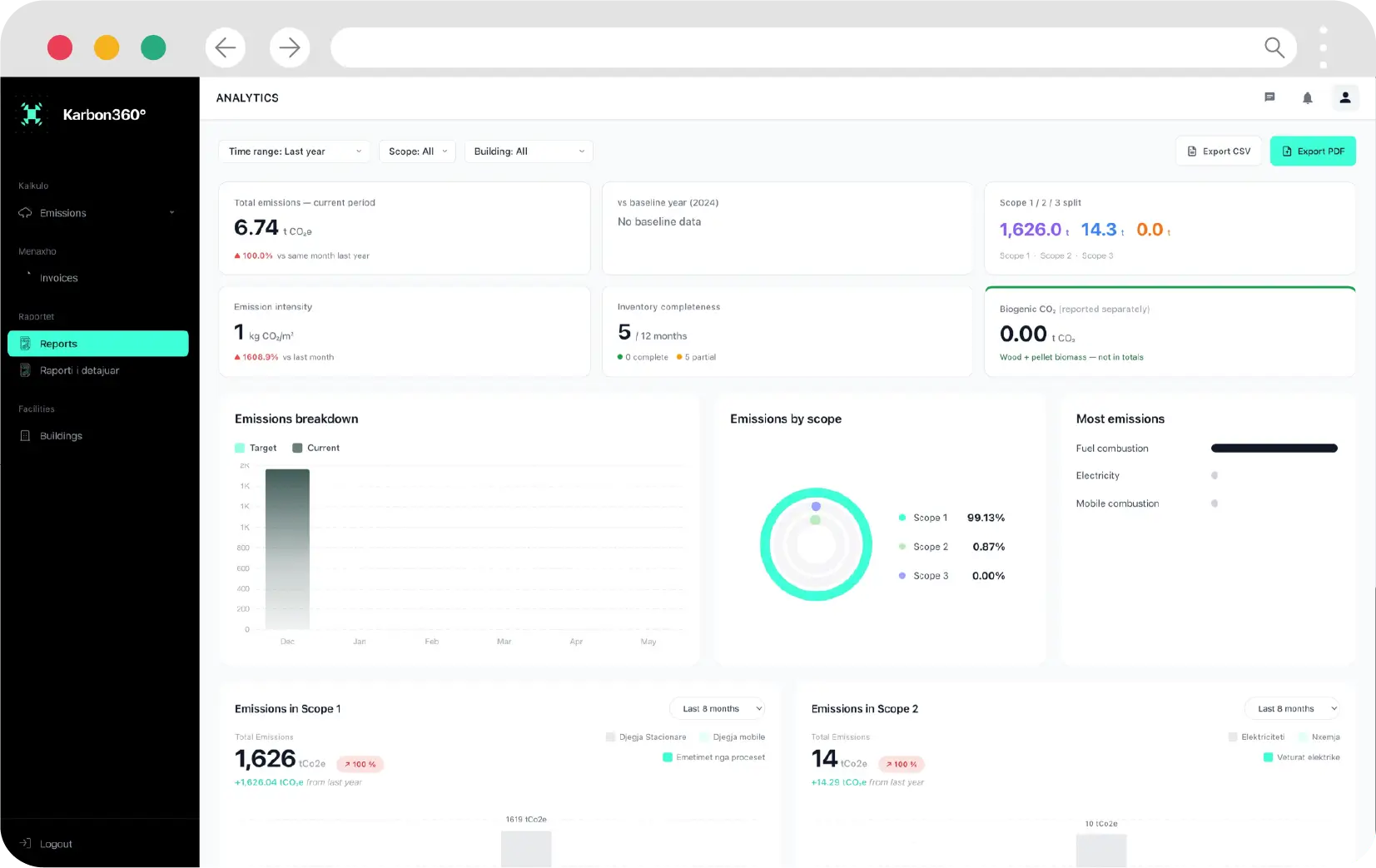
Karbon360°
Karbon360° prepares CBAM emissions reports with a calculation trace on every figure, country-specific factors with source and version, and every record recalculated on the server, so verifiers check evidence instead of rebuilding numbers.
The declaration is due in September. The verifier's calendar fills long before that.
Frequently asked.
When can CBAM verification start for 2026 emissions?
What is the deadline for CBAM verification?
Who hires the CBAM verifier, the importer or the producer?
Does one verification cover all my EU customers?
Is a site visit required for CBAM verification?
What happens if my emissions are not verified in time?
How many accredited CBAM verifiers are there?
Does Habitat verify emissions?
Book the data before you book the verifier.
Send us your installations, goods and customers. We will prepare the 2026 emissions report and evidence pack and help you secure an early verification slot.